A car subscription business that onboards slowly, or relies on manual document checks and phone calls to verify identity, has a conversion problem before it has a compliance problem. The applicant who is asked to email a photo of their driving licence and wait three days for approval rarely becomes a subscriber at all.
The right KYC software for car subscription fixes both problems at once. It verifies identity, checks the driving licence, and assesses affordability inside the booking flow, quickly and accurately, with minimal effort from the subscriber. In car subscription, the compliance outcome and the customer experience outcome are the same thing. This guide explains how KYC works, which checks dealers and OEMs need, and how the rules differ between the UK and US.
TL;DR
- KYC in car subscription covers identity verification, driving licence validity checking, and credit or affordability assessment. All three should complete digitally within the subscriber onboarding flow, not as a separate offline process.
- In the UK, HM Treasury guidance published on 26 February 2026 confirms that firms can use certified Digital Verification Services on the GOV.UK register to verify identity under the Money Laundering Regulations 2017, building on the framework set out in the Data (Use and Access) Act 2025.
- Automated driving licence checks through the DVLA in the UK, and DMV data verification in the US, let platforms confirm licence details in seconds rather than days.
- Modern subscription platforms can complete full KYC onboarding, including identity, licence, and credit checks, in under ten minutes for most applicants.
- If a subscriber fails a check, the platform should explain what failed and what the next steps are, rather than sending an opaque rejection that prompts a call to the operator.
What Is KYC in Car Subscription and Why Does It Need Specialist Software?
KYC, or Know Your Customer, is the set of identity verification and due diligence checks a business carries out before entering into a relationship with a customer. In financial services, KYC is a regulatory requirement under anti-money laundering legislation. In car subscription, the regulatory dimension is usually lighter, but the practical need is the same: an operator needs to know that the person taking a vehicle is who they say they are, holds a valid licence to drive it, and is likely to honour the financial commitment they are making.
For car subscription, KYC typically covers three distinct checks:
- Identity verification: Confirming that the applicant is a real person using their own identity. This involves verifying a government-issued identity document, such as a passport or driving licence, and confirming that the person presenting it matches the document through biometric and liveness checks.
- Driving licence validity: Confirming that the applicant holds a licence that is valid for the class of vehicle being subscribed to, that it is current and not suspended, and that no disqualifications or restrictions would prevent legal use of the vehicle.
- Credit or affordability assessment: Confirming that the applicant is likely to meet the monthly payments. This may be a formal credit check with a credit reference agency or a lighter affordability assessment, depending on the operator's underwriting approach and the jurisdiction.
General-purpose KYC tools built for banking cover the first check well but rarely handle licence validity or the subscription-specific decision rules that tie all three checks to a vehicle booking. That is why KYC for car subscription works best when it is built into the car subscription booking system itself.
How Does Digital Identity Verification Work in a Subscription Sign-Up?
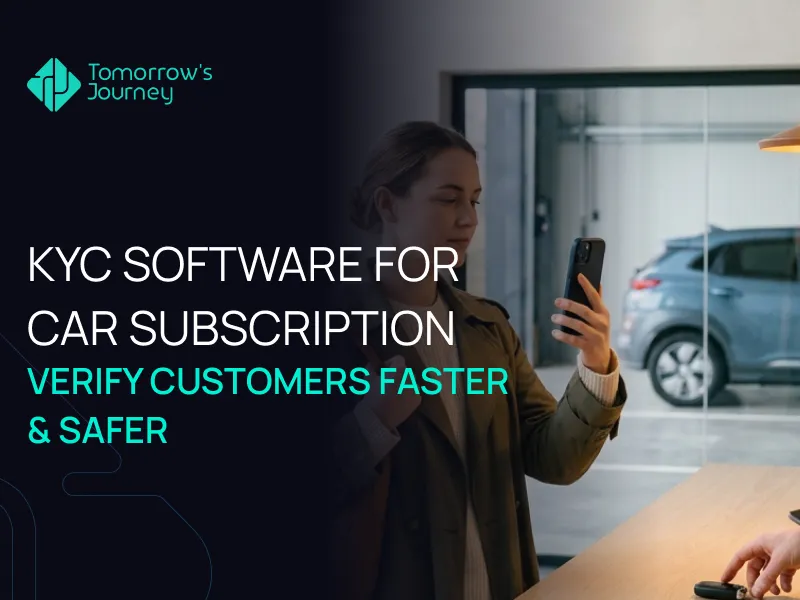
A well-built subscription onboarding flow treats identity verification as a step within the booking journey rather than a separate offline process. The subscriber does not leave the platform, email documents, or wait for a manual review. The whole sequence completes on the same device in minutes.
The technical sequence typically runs like this:
- The subscriber is prompted to photograph or scan their identity document, usually a passport or driving licence.
- The platform's integrated verification service checks the document's authenticity, including holograms and security features, extracts the document data using OCR, and cross-references it against government identity databases where permitted.
- A biometric check compares the applicant's live selfie with the photo on the document, using liveness detection to confirm the applicant is physically present rather than holding up a photograph of the document holder.
- The verified identity data is matched against credit bureau records, electoral roll data, and other independent sources to confirm the identity is real and not fabricated.
- The result is returned to the onboarding flow, typically within 30 to 60 seconds, as a pass or refer decision.
In the UK, this process now has clearer legal standing. The Data (Use and Access) Act 2025 put Digital Verification Services (DVS) on a statutory footing, and HM Treasury guidance published on 26 February 2026 confirms that firms can meet their Regulation 28 identity verification obligation under the Money Laundering Regulations 2017 by using a certified service listed on the GOV.UK DVS register. The guidance also makes clear that digital identity does not cover every aspect of customer due diligence, and that the firm remains responsible for its checks.
The UK is also moving towards digital driving licences. The DVLA's pilot has concluded and the service has been described as ready for rollout through the GOV.UK Wallet, although a public launch date has not yet been confirmed. Once it is live, certified providers will be able to verify digital licence credentials programmatically, reducing friction further for subscribers and operators alike.
What Checks Are Required Before Approving a Subscriber?
The checks required before a subscriber takes delivery of a vehicle depend on the operator's underwriting policy, the jurisdiction, and whether the subscription is a consumer or business product.
Consumer subscriptions in the UK
- Identity document verification: A passport or driving licence check confirming the applicant is who they claim to be.
- Driving licence check: Confirmation through the DVLA that the licence is current, not suspended, and not subject to a disqualification or restriction for the vehicle class. Subscribers can share their record using a DVLA check code, which the operator enters on the GOV.UK driving licence checking service, or the check can be automated through an approved licence-checking provider.
- Credit or affordability check: Typically run against Experian, Equifax, or TransUnion to confirm the applicant meets the operator's acceptance criteria.
- Minimum age: Confirmation that the applicant meets the operator's minimum age requirement, which for most UK operators sits between 21 and 25.
Business subscriptions
Business subscriptions may require verification of the company as well as each driver. This includes confirming the business's registered status, through Companies House in the UK or the relevant state registry in the US, assessing the company's financial standing, and running individual identity and licence checks on each named driver.
Consumer subscriptions in the US
In the US, licence data can be verified through the American Association of Motor Vehicle Administrators' (AAMVA) Driver's License Data Verification service, which confirms whether the details on a licence match the records held by the issuing state, across participating jurisdictions. Licence status, class, and endorsement history are typically checked separately through a motor vehicle record (MVR) report from the state. Credit assessment follows standard US credit bureau processes, governed by the Fair Credit Reporting Act (FCRA) rather than the FCA framework that applies in the UK.
How Long Should Onboarding Take on a Modern Platform?
For a standard consumer subscription with no complications, the full KYC sequence, including identity verification, licence check, and credit assessment, should complete within 5 to 10 minutes on a well-built platform. The subscriber should not need to contact anyone, email documents, or wait for a manual review unless their application raises a refer or decline decision.
The commercial argument for fast onboarding is direct. Industry research into financial services onboarding has repeatedly found that a significant share of applicants abandon sign-ups that feel slow or complicated, and vehicle subscription operators face exactly the same risk. A subscriber who starts an application at 10pm on a Sunday and is told to wait until Monday for a manual licence check does not become a subscriber that week.
The platforms that achieve sub-10-minute onboarding do three things:
- Integrate verification services directly into the booking API rather than running them as a manual step
- Use automated decision rules that clear most standard applications without human review
- Design the subscriber-facing flow around the verification steps, rather than bolting verification onto an existing booking form
What Happens If a Customer Fails a Credit or Licence Check?
Rejection handling is one of the most commonly under-designed parts of subscription onboarding, and it has a direct impact on the operator's reputation and subscriber experience.
A subscription platform should clearly distinguish between three outcomes:
- Hard decline: The applicant does not meet the operator's acceptance criteria and cannot proceed. The communication should explain what was checked and, within the limits of data protection law, why the application was declined. Naming the credit reference agency used and explaining the applicant's right to access their credit file is good practice, and in many cases a legal requirement.
- Refer to manual review: The application cannot be cleared automatically but may be acceptable on further review. The subscriber should be told how long the review takes and how they will hear the outcome. This category should be reserved for genuinely ambiguous cases. Using it as the default for any non-standard application defeats the purpose of automated onboarding.
- Licence restriction: The subscriber's identity is confirmed, but their licence has a restriction or endorsement that prevents them from taking the specific vehicle class. The platform should explain this clearly and, where possible, suggest an alternative vehicle the licence permits.
Treating every declined application the same way, with a generic rejection message, generates the highest volume of customer service contacts at the worst possible moment in the subscriber journey.
How Does KYC Differ Between the UK and US?
The rules governing identity verification and credit checking differ materially between the UK and US, with practical implications for how subscription platforms are configured in each market.
UK regulatory context
Identity verification for anti-money laundering purposes is governed by the Money Laundering Regulations 2017, and since February 2026, certified Digital Verification Services can satisfy the identity verification requirement digitally. Most consumer subscription operators do not fall within financial services regulation for the subscription product itself, but they may for any credit activity they carry out, in which case FCA rules on customer due diligence and credit assessment apply.
Driving licence checks use DVLA data, either through a check code shared by the subscriber or through an approved provider that automates the check via API. The billing side of the subscription then needs to meet PCI DSS and UK GDPR requirements for the payment and personal data collected at onboarding.
US regulatory context
No direct equivalent to the UK's Money Laundering Regulations applies specifically to vehicle subscription. Identity verification is shaped by a mix of state consumer protection laws and sector-specific rules. Mobile driver's licences are also gaining ground: in September 2026, FinCEN and the federal banking agencies, including the NCUA, issued joint FAQs confirming that banks and credit unions may accept mobile driver's licences to meet customer identification requirements. That is a signal of where identity verification across consumer services is heading.
Licence data verification uses AAMVA's service in participating states, with motor vehicle records used to check status and endorsements. Credit checks follow FCRA requirements, including the obligation to send an adverse action notice when a credit-based decision results in a less favourable outcome for the consumer.
How the JRNY Platform Handles Subscriber Onboarding
The JRNY Platform builds identity verification, driving licence checks, and credit assessment into the subscriber booking flow, so applicants complete KYC on the same device, in the same session, without emailing documents or waiting for a call back. Verified data feeds straight into the subscriber record, contract generation, and payment setup, so there is no re-keying between onboarding and billing.
It is the same platform behind MOOV by Al-Futtaim in the UAE. For a wider view of the market, see our roundup of the best car subscription software, or book a demo to see the onboarding flow in action.
Key Takeaways
- KYC is three checks, not one: Identity, driving licence, and credit or affordability all need to clear before a subscriber takes a vehicle, and all three can run digitally.
- Speed is a conversion lever: Onboarding that completes in under ten minutes keeps applicants in the funnel. Manual checks lose them.
- UK digital identity now has formal backing: Certified Digital Verification Services can satisfy the Money Laundering Regulations identity requirement, though operators remain responsible for their wider due diligence.
- Design the decline journey: Clear, specific explanations for declines, referrals, and licence restrictions reduce support contacts and protect the brand.
- Configure by market: UK operators rely on DVLA data and FCA rules for credit; US operators rely on DMV data, MVRs, and the FCRA.
FAQs: KYC for Car Subscription
1. Why does a car subscription require identity verification?
Identity verification confirms the person entering the subscription is who they claim to be. It protects the operator against identity fraud, ensures the vehicle is driven by a licensed and eligible driver, and supports any credit or affordability assessment the operator carries out before approving the subscription.
2. Can identity verification for car subscription be completed entirely digitally?
Yes, on platforms designed for it. Modern subscription platforms integrate identity verification services that let subscribers complete document and biometric checks on their phone or computer without printing, emailing, or visiting a branch. In the UK, HM Treasury guidance published in February 2026 confirms that certified Digital Verification Services can be used to meet identity verification requirements under the Money Laundering Regulations.
3. What happens if a subscriber's driving licence is flagged during verification?
The platform should explain the specific issue clearly, whether that is an expired licence, a disqualification, or a restriction on the vehicle class, and direct the subscriber to the right resolution, such as renewing their licence. Where the issue is an endorsement rather than a disqualification, the operator may still be able to approve the application, subject to modified insurance terms.
4. Is a credit check always required for car subscription?
Not always, but most operators run some form of affordability or credit assessment before approving a subscription. The approach depends on the operator's underwriting policy, the value of the vehicle, and the jurisdiction. Some operators use a soft search that does not leave a visible footprint on the applicant's credit file; others use a full hard check. The type of check should be disclosed to the applicant before it is run.
5. How long does KYC take for a car subscription?
On a well-built platform, identity verification, licence checks, and credit assessment together take 5 to 10 minutes for a standard application. Only applications that are referred for manual review should take longer, and the subscriber should be told how long that review will take.